Monday, July 07, 2008

Neal Siegel


On a magical journey through a unique sculpture garden I looked forward to photographing an array of bold forms of clay, stone and steel. What I found buried within the obvious was a tabletop reflection of autumn foliage and light.
In November, 2006 I was diagnosed with a brain tumor. My life has changed, but my desire to create has not. As the reflection in the tabletop inspired me to move in a new direction, I have altered my approach to the creative process. While my great passion will always be composing and capturing an image in the camera's eye, I find great satisfaction in the art of printing.
I have been a very fortunate man and have been to many exotic places in the world.
This is a good time for me to revisit my visions and share them with others.

Saturday, July 05, 2008

Sean Callahan

Dogs best friend

I have been a patient at NIH for over fifteen years. I am so incredibly grateful to everyone there for all they have done for me during this time. In many ways NIH has been a driving force in having me explore my creative side. While going through treatments there I started painting in watercolor and I have been on a creative journey ever since. Many of my paintings are dog related because I am inspired by dogs and the unconditional love they show us on a daily basis. I believe dogs have the ability to heal us emotionally and physically. I live in Vermont and have two yellow labs that are my constant companions and have taught me many life lessons. Some of these paintings are of these gentle souls that have changed my life forever, and of other dogs that I have met along the way.I am very honored to have this opportunity to share my watercolors with fellow patients and their loved ones at NIH. I have walked the halls of NIH over the years during times of stress, sadness, concern. The artwork has always been a way for me to find peace. I hope that my paintings can bring a smile, evoke thought, or bring back a happy memory while they are there.

Monday, June 30, 2008

Cary Brown


After a life-threatening experience in 2005 involving cancer of the appendix, I moved inward. I felt a need to take a closer look -- a need to really feel and see life and death. Instead of painting vast landscapes, I pushed into it. I began to read a lot of poetry. My appetite grew for that big question: What is this all about? What is reality all about? What's going on above us, below us, on the surface of an orchid, in the heart of a woodpile, in the mind of a bird? So began my journey with this new work. Having studied photography at U.Va, I was drawn to the medium again when contemplating reality. The Polaroid emulsion process was a perfect match: it enhanced the ephemeral qualities, the elements of surprise and humor in nature. It allowed me to create wind and to be able to bend wallpaper, which seemed then to take on layers of reality infused with the strangeness of poetry that help things meet in that middle area of chaos and order, where truth -- perhaps -- hovers. I yearned to freeze all of that so I could study it. Of course, gradually the work began to take on a life of its own. Through the process I began to consider the spirit in these objects -- the light, the love, the energy, the beauty, the magic-- in essence, the truth. A story evolved: I would see it, hear it, and then go in with color, form, and sometimes words and bring the piece alive. After this I began to comprehend Emerson, Eiseley, and Dillard, all authors whose words were meaningful to me. I followed their assertion to really, really look and be a conscious witness. In this way so much more will be given to you. I kept exploring and came to the woodpile of an old ash tree we had to cut down on our farm. Here I mourn her in two pieces. In the last image, The Moo Piece, I saw through a child's eyes, where the innocence is, real intuition. I began to think of dreams, time travel, and the cosmos, then returned to my pot of boiling elements: wind and clouds bubbling in water, along with wood piles, donkeys, cows, flowers, birds, land, dust, and the laws of nature. I began to laugh, and it was then I knew I had been restored -- my soul had been fed and magically returned to its great capacity for joy.

Tuesday, January 29, 2008

Novie Trump


My work is influenced greatly by the ancient relics and stories of past civilizations that I studied as an archaeologist. I am particularly drawn to massive stone markers- Mycenaean beehive burial mounds, Mesopotamian steles, Egyptian columns and Celtic monoliths. These time-worn stone monuments inform the shape and heft of my sculptures, while their weathered patinas inspire my layered surfaces.
In conjunction with these monumental forms I often use archetypal symbols taken from ancient myths and tales. These iconic images take many forms: the bird as harbinger and messenger, bones as touchstones of quiet power, the forest as a threshold to the unknown.
These symbols are used to express such universal human experiences as love, loss, fear, death, courage and transformation.

Martha Oatway


Math Series was inspired by a hydrodynamics textbook published in 1890. Most pages are covered with individual equations and their derivations, which are very abstract visual images to me. The equations, punctuated by prose, become an exercise in positive and negative space. I combine the hard equations with organic forms from my etching, drypoint and woodcut plates as well as additional geometric symbols. By uniting the disparate elements of chaos and order, I have created my own visual language.In the time since I started Math Series, I have had the honor of working with several scientists and mathematicians and have incorporated their work into my prints.Knowledge Series stems from Math Series; here I have introduced biological elements along with organic molecules, tables and graphs.All the prints are monoprints, which are one-of-a-kind prints with a repeatable matrix. I combine paper lithography with collagraph, etching, drypoint and woodcut plates to create the images. Each color represents a separate pass through the etching press.

Barbara Tyroler


In Beijing Impressions; Portraits of a Foreign Landscape, Tyroler examines the figurative landscapes synthesizing the ancient with the contemporary, the literal with the metaphoric, to reflect the people and the city in cultural and political transformation. The resulting exposures provide a foreign, yet intimate vision, influencing a tone of multi-layered introspection and transition.

The Understory:Overlooked Beauty from the Forest Floor
Isabel McLean Mixed Media /Textile Artist
Every blade in the field,
Every leaf in the forestLays down its life in its season
As beautifully as it was
Taken up
Henry David Thoreau

Only when man has done as much, may he call himself the equal of a weed.
Donald Culross Peattie

I create art celebrating the understory of the forest—the overlooked beauty found in nature often labeled debris. I see extraordinary beauty in natural items that can be found simply underfoot on the forest floor.I collect often unnoticed fragments found on hikes and walks- from galls found in goldenrod stems along a trail, to rosehips that have fallen from climbing rose vines, to catalpa pods scattered along the sidewalk, to pinecones resting in a bed of pine needles. I then compose the forms three-dimensionally, accentuating shape, texture or color to create dynamic compositions.To catalogue the simplicity and natural beauty inherent in natural detritus, I create a felt “canvas” by washing, pounding and dying sheeps wool. I then arrange the blooms or pods into a composition and sew the collected pieces onto the wool felt.Through the fragility and impermanence of my art, I hope the viewer will notice the overlooked beauty found in the world around us—the green of a new seed pod, the interesting differences between a row of galls, or the pale pink of a fading bloom.

Tati Kaupp


My work, both painting and ceramics, involves the observation ofdomestic habitats, still lifes that are not still. I focus on decorativedomestic objects, like pottery forms and chairs, and describe theiractivity in a setting- landscapes and ecosystems within a domestic realm. Interior objects and exterior nature commingle in a habitat of my own making.

Jeff Wilson


The beaches on the Outer Banks of North Carolina are a constant source of inspiration for my paintings. It is no wonder that man first learned to fly there. Everything seems to be flying there; sand, sea, clouds and sometimes even rooftops. It is the windiest place I know. It seems in perpetual motion, a world of waving grasses, pounding waves, and shifting shadows. I have vacationed and painted there for over twenty years. Almost every painting in this exhibit was started there. It has been my Arles.I have always considered myself more a painter than an artist, if I may make that distinction. An artist is one who makes a statement about society or human nature or about himself/herself; I am more concerned with using paint in response to what I see. I am a realist painter. I marvel at paints ability to render figures and objects and to create atmosphere, mood and drama. Most of all, I am a painter of light. But what makes me an artist is that I am a recreator. I take in what I see and watch it appear on the easel new and changed. The painting becomes a vision fused with my ideas, moods and memories, transformed by my skills and limitations. It is influenced by other painters I see and study, the music I listen to, my physical comfort or discomfort and the perseverance and dedication I give to my intension. It is this aspect of my artwork, never knowing exactly what will transpire, that keeps me motivated and intrigued.Many of the works in this show are the result of a continuing investigation into painting on copper panels. Many artists over the years have experimented with this substrate, including Rembrandt, Goya, El-Greco and Chardin to name just a few. It has significantly changed both my approach to painting as well as the finished works. My paint application uses thin glazes and the paintings have a smoothness that is the inherent nature of the copper panel. Copper also lends an illumination to the work where the warm tones of the metal are allowed to peek through the thin paint layers. I also like to employ an etching technique of drawing into the wet paint that also reveals the warm copper ground.My employment at the National Gallery of Art in the Design and Installation Department has also been a tremendous source of inspiration for me and my art. Working so closely with some of the greatest art of the ages has given me a first hand insight into the lessons and techniques of arts great masters.

Barbara Southworth


"There's something about the winter light that is beautiful in its own right," said Southworth, a fine-art photographer who favors wilder landscapes over gardens. "I don't know if there's a correlation between getting to be of a certain age and feeling more comfortable and at home in winter."
Water, rendered soft-edged and flowing, is a recurring subject, and she is drawn to the vibrant green hues of winter found in lichens and mosses. Nature, she says, can tell us a lot about how plant communities grow and coexist, good lessons for the gardener, even in winter.
"What we are saying here is that nature doesn't die, it's just a time for getting ready for coming back, the quiet before things break loose and the delirium of spring in Washington," Southworth said.
Excerpt
Stripped Bare, Winter Scenes Reveal the Artistry of Nature
By Adrian HigginsThursday, January 3, 2008

Sheep Jones

Sheep, whose given first name is Elaine, grew up the oldest of five in rural Maine, with parents who did not support her artistic plans. They wanted her to make a decent living, but creating art "was all I ever wanted to do," she says. She acquired the nickname Sheep as a teenager trying to grow out her bangs, and it stuck.
After getting a degree in fine art at the University of Maine, Sheep married her high school sweetheart, Charles Jones, and followed him from one academic job to another. She painted in her spare time and in her twenties had one successful art show. She never forgot how good it felt.
The couple moved to Fairfax in 1987, when Charles landed a tenured position at George Mason University. For several years, while raising two sons and working as a waitress, Sheep had no time to paint.
But she started entering local art shows again in her forties, and almost immediately began winning awards. In 2000, she became a resident artist at the prestigious Torpedo Factory Art Center in Old Town Alexandria.
Sheep has limited depth perception, the result of an accident at age 3 that left her blind in one eye. She and others wonder if her unique visual perspective may have something to do with her success.
"That is something people really do talk about, is the layering in her work, and I think she's probably overcompensating for the fact that she can't see in one eye," says Jennifer Glave Kocer, director of the Rentz Gallery in Richmond, which carries Sheep's work.
Many of Sheep's paintings depict scenes from farms and nature, including fanciful renderings of plants and their roots, as well as dirt and the creatures that live in it. "When you pull up the roots of a plant, you don't know what else is down there. I just let my imagination go," she says.
Excerpt from the Washington Post
Making It
By Margaret Webb PresslerSunday, October 22, 2006

Monday, January 28, 2008

Margaret Huddy


Margaret Huddy watercolor

Joanne Miller


My photographic expression reflects a journey of connection and introspection. Walking a path at nature’s pace, the wisdom of life is revealed in the details. Raised in the suburbs of Washington D.C., the natural world was presented in the context ofmy backyard and neighborhood environment. I valued simplicity and harmony, and sought freedom of spirit. Chasing butterflies with a net, keeping cocoons in jars onmy windowsill, I was a collector of quiet beauty.During my twenties and thirties, I worked professionally in art galleries and as a location scout for television commercials and documentary films. These experiences broadened my vision of the world.At age 34, I moved to a houseboat on an estuary of the Potomac River ten miles from the U.S. Capital. My relationship within nature was seamless. Living the cycles of life, for four years I photographed animals common to an urban river: crows, blue heron and deer. The grace of a wing, an isolated splash from a landing, minimal details reduced to their essence in black and white. These images are not lonely ones, they share a quiet contentment.Like the wildlife I photograph, my expression is instinctive and intuitive. Life on the river is timeless. Days turn into years. And then like the seasons of change, I moved back to the suburbs.Now in my 40’s, I continue to explore the co-existence of nature and civilization. As the challenges of modern life come in closer, my journey with a camera continues to delve deeper into the essence of beauty. Whether sharing these experiences with others or on my own, I find that a connection to nature is essential for our spirits to thrive.

Anne Massoni


the body of work i have pursued for my thesis is about inherited illness. more specifically, the illness of endometriosis that has been passed down from mother to daughter in my family for at least three generations. endometriosis is a “silent” chronic illness that affects millions of women. it is considered “silent” because it has no outward signs, no visible indications of illness and because endometriosis can come and go. the reason why it happens is not fully known and it varies in degree depending on a long list of factors. millions of women suffer silently because it is hard to diagnosis (with little medical relief), is often misdiagnosed, or they are told the illness is in their head. this illness has affected almost every woman in my family and yet until i started sending my images to my family over the internet, i didn’t know about their illness and they had no idea about mine.illness related to female reproductive organs is often not talked about at all; it is for many women something of which to be ashamed or secretive. in my family, my grandmother died of ovarian cancer at 56 (i was three), my mother in an effort to avoid ovarian cancer had a complete hysterectomy at the age of 35 (i was eight) and i, at 26, was diagnosed with the same fibroids my mother and grandmother had and which left untreated could result in ovarian/uterine cancer. being part of this medical pattern is daunting and yet i find myself unable to express extreme emotions of anger or frustration because of my familial relationship to my mother and grandmother. perhaps it is not the burden of possible illness and current illness but rather the significance of a seemingly cyclical pattern that not only is the source of this work but the connection that most frightens me.the work i am doing for my thesis involves several factors: inheritance, illness, silence and the unease of illness and pain. the work stems from the own emotional and physical pain of dealing with my endometriosis, as well as the connection that i share with my mother and my grandmother. the images are built, through computer manipulation using found snapshots of my mother, grandmother and me. each image also contains medical information in the form of medical diagrams, drawings or photographs. the snapshot, a type of image with which we are all familiar with, serves as a point of identification with the viewer and speaks of history and fragmented memory. the repeated faces of these three women at different ages help to identify for the viewer the notion of inherited family traits passed on from one generation to the next. on the other hand, the snapshots are cropped and manipulated to such a degree that a sense of discomfort develops as the viewer, at times, can only make out the idea or glimpse of a person. layered medical diagrams illustrate the notion of a subtext beyond an inheritance of features alone. the mood and tone of the images both hint at familiarity and discomfort.

Brooke Rogers


The common yellow pencil serves in these works as a metaphor for creation. The poet writes with it, the artist sketches with it. Twisted and curling, looping and leaping, the work of creation is a muscular and robust activity. By extension, the pencil suggests the written word, specifically the central role played by ‘The Word’ in the Biblical creation narrative. The works shown at NIH are from a series of gouache paintings, (gouache is like watercolor, but more opaque), entitled Psalter – an old word for the Bible book of Psalms. As often as not, it is God’s role as creator that the psalmist magnifies through his hymns of praise. It is as hymns of a sort that these pencil paintings not only describe an energetic and encompassing space, but fill that space with the music of creative utterance.

Bill Mould

I am drawn to working in ceramic clay because of its inherently ambiguous nature. It is extremely flexible at the start, and dangerously brittle just before firing. Coming from the earth, it has a solid reality, but when worked it can become intensely spiritual. The clay is ready to assume many shapes, textures and meanings.
As a linguist, I am fascinated by language. How difficult it is to express thoughts and events through words, and how easily those words slip from context and acquire ritual meaning far beyond their syllables. And frequently texts are partially effaced to make room for new words, just as our beliefs and passions change shape to accommodate the new.
With words from Hippocrates, Sophocles, the Old Testament and the New; with symbols from Assyria and Sheba, ancient America and modern robotics, these sculptures are meant to evoke lost worlds, hidden meanings and the eternal truths of ritual.

Tom Cogill

These photographs were taken between 2001 and 2004 in San Mateo Ixtatan, a remote town in the mountains of northwestern Guatemala, in order to publicize the work of the Ixtatán Foundation.

Hee Sook Kim


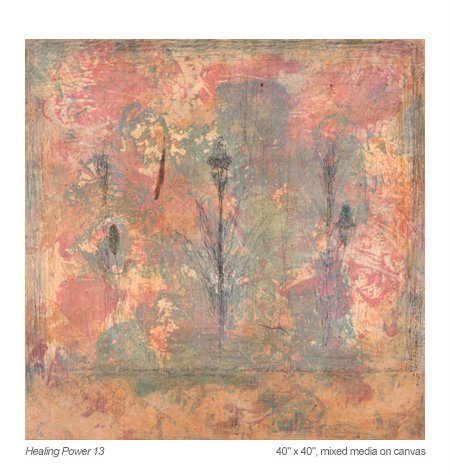
My work is based on the spiritual and healing power of nature related in childhood memories and cultural disclosure of hidden, ambiguous, mysterious, yet empowering aspects of Korean women: awareness of female identity has been intertwined with ancient Asian philosophy, herbal remedies for curing diseases and disorders, and mysterious reminiscences of childhood.My interests in nature, mysterious healing power of it, began in 1995 when I placed an acupunctural diagram of a human body in a work on paper. Right after the September 11, thoughts on life and death budded and grew based on personal experiences. Organic shapes and leaves stared to appear as the implication of generational rotations of a life’s circle. Acceptance of mental and physical sufferings and loss of lives responded through searches for the cure and healing of them in progress: images of herbal plants and texts of herbal treatments used in different cultures emerged gradually. In the summer of 2003, a residency in Taos NM, lead me to a different stage of collecting natural plants in mountains and prairies. It transformed into the creation of communications through spaces, words and languages, lines and shapes, colors and emotions, layers and mysteries, lightness and darkness, and consciousness and fate.In my childhood, herbal remedies were common methods my grandmother always used for treating various physical disorders and diseases, which reminded me of the increasing interests in Asian herbal remedies to cure diseases as a reasonably fresh attitude towards unknown knowledge; ancient Asian theory states that we could find a remedy in herbs if there is a disease. Images of wild herbal weeds are carefully selected to deliver their inherent natures to cure physical, mental disorders and diseases. Texts are adopted to prove medical effectiveness in remedies; herbal remedies as recognition of a different culture, Asian culture in this country. Visually layered surfaces are designed to create ambiguity, mystery, hidden power, and spirituality.Words are openings, portals to other worlds rooted in magical places where sense is a new way of thinking, where thinking is embodied in breathing. Intimate visual spaces conjured by spirituality invites viewers to a special journey: into an imaginary land, the work.

Laura Ferguson


Laura Ferguson talks about making The Visible Skeleton Series.I have scoliosis, a deformity of the spine. My body's asymmetry creates the need for a subtle effort of balancing, in my physical relationship to gravity and space, as well as in my psychic sense of centeredness and wholeness. The conscious awareness of walking, moving, breathing - bodily processes that usually unfold by themselves - has made me attuned to my bones and muscles, nerves and senses, like a dancer. Drawing my body, I focus on this heightened awareness and transform it into visual imagery. My drawings seek to create a visual counterpart to the texture of kinesthetic experience: that inner-body awareness that is at once the most universal yet most private aspect of being. Making this work has been a learning-through-drawing process. It has given me a deepened visual understanding of my own body and a connection to that which is unique in each individual. Together, the drawings that form The Visible Skeleton Series tell the story of my journey and how I transformed my body's experiences into art.I think of the series as being the equivalent of three-dimensional sculpture: a way of being able to view this body from many different angles and perspectives. Using myself as subject and model allowed me to work from the inside out as well as the outside in. The more I tuned in to the interactions of my bones and muscles, nerves and senses the more I focused on my self, paradoxically the more I was able to transcend my own personal experience and speak to something universal in my work as an artist.The Visible Skeleton Series project began almost twenty years ago, when I started to experience physical disability related to my scoliosis, and felt the need to understand what was happening to my body. I had undergone spinal fusion surgery at age thirteen, and had been fine for many years afterward. Because I am an artist and tend to think in visual terms, I needed to be able to picture what my scoliotic spine looked like. As I began to learn about anatomy, I realized that the imagery was quite visually compelling, and could be interesting on many levels, from the literal to the metaphorical. I decided to undertake an artistic inquiry into scoliosis.Scoliosis is a flawed model of the beautifully designed human musculoskeletal system, but I wanted to portray it as having its own more complex beauty, one that viewed deformity as differentness, and differentness as individuality. I studied anatomy with Irene Dowd, a noted teacher and neuromuscular trainer who helped me to understand the dynamics of the body in motion. I retrieved and studied the records of my surgery, a fusion of the T5-12 vertebrae, with grafted bone, performed by Dr. John Cobb, which was followed by a year in a plaster turnbuckle body cast. I also was privileged to be given access to the Anatomy Lab at the Weill Medical College of Cornell University, where I have spent many hours drawing from the skeletons.Scoliosis is a complicated rotational deformity, and the process of conceptualizing it three-dimensionally has been challenging but rewarding. At first I used my own x-rays as the basis for my drawings. Later I consulted with orthopaedic surgeons and radiologists for information and help in having medical images made specifically for the purpose of making art. Thanks to Dr. Andrew Litt and Phillip Berman at NYU Medical Center, I was able to have a 3D spiral CT scan, an exciting new technology that allows me to view my skeleton from any angle, rotating and tilting it to match whatever movement or pose I'm interested in drawing.Creating images of my body that are anatomically accurate, but also personal, has felt empowering, as if I were regaining a sense of ownership of my own body that had somehow been lost when my experience was medicalized. The more I understood and internalized the configurations of my unusual body, the more graceful and comfortable I felt in my skin and the more manageable my pain and disability have become.

Duane Keiser